
Hockey Jersey Sublimation: What Teams Should Know Before Ordering
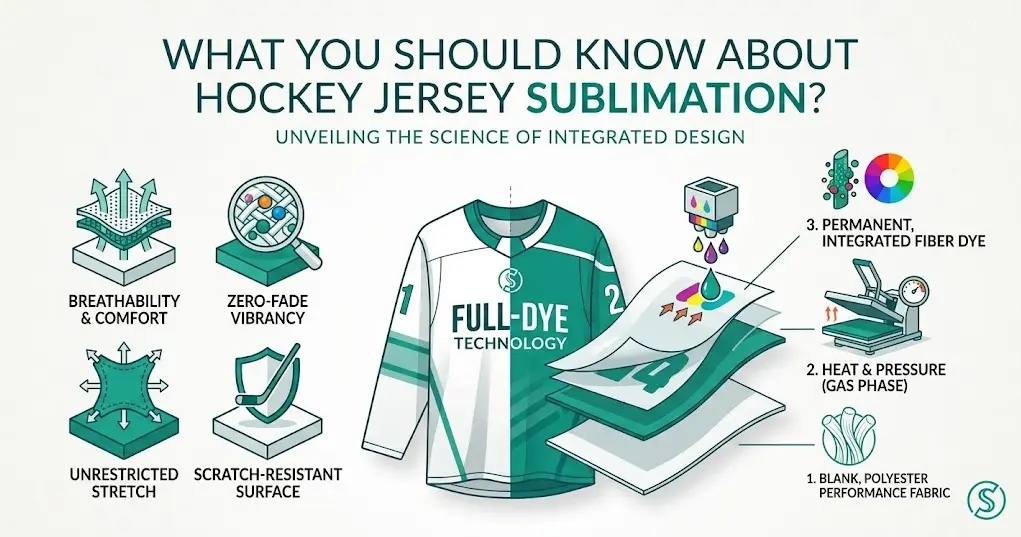
Sublimation is popular in hockey because it can carry names, numbers, logos, gradients, and full-body graphics without stacking extra material on top of the jersey.
That does not mean every sublimated jersey is equal. Fabric, proofing, artwork quality, and care instructions still decide how professional the final order feels.
The useful question is not whether sublimation works. It is whether the fabric, design, and order process are right for your team.
Understand what the process does
Sublimation uses heat and pressure to bond dye into polyester fibers. The design becomes part of the fabric surface instead of sitting on top like vinyl or a stitched layer.
That is why a decorated jersey can feel smooth even when it has multiple colors, sponsor logos, sleeve numbers, and a full back layout.
Use this quick checklist before moving forward:
- Best on polyester-heavy fabric: Confirm fabric compatibility before choosing the method.
- Smooth finish with no raised print: Useful when teams want lighter decorated jerseys.
- Good for complex graphics: Helpful for gradients, sponsor marks, and full-body patterns.
- No separate number layer: Names and numbers can be part of the design itself.
- Works well for full-team personalization: Keeps roster-heavy orders easier to manage.
Use it when design freedom matters
This method is strongest when a team wants custom striping, gradients, shoulder patterns, multiple logos, or every player name and number included without changing the construction.
For beer league, youth programs, tournaments, and training teams, that can make the order easier to manage.
Compare it honestly with tackle twill
Tackle twill has the traditional stitched look many players associate with pro jerseys. It also adds weight, labor, and cost.
Sublimation is lighter and more flexible for complex artwork. If the team wants a classic raised-letter feel, twill may still be the better call.
Care still matters
A sublimated design is durable, but the garment is still a performance fabric. Wash cold, avoid bleach and fabric softener, and hang dry instead of cooking it in a hot dryer.
Bad laundry habits can age any jersey faster than normal play.
Where sublimation can disappoint
Sublimation is not magic. If the artwork is low resolution, the fabric is wrong, or the proof is rushed, the finished garment can still look weak.
It also will not create the raised, stitched texture of tackle twill. Teams that want that traditional premium feel should compare both options before deciding.
Why it works well for roster-heavy teams
Names and numbers are usually easier to manage because they are part of the design file. That helps teams with large rosters, youth programs, and event orders where every player needs a different back.
The value is strongest when the team uses the design freedom, not when it only needs a plain one-color practice top.
Questions to ask before approving the order
Ask what fabric is used, whether names and numbers are included, how color matching is handled, and what the care rules are. Those answers matter more than a generic promise of durability.
Also ask whether replacement pieces can be ordered later from the same artwork.
Details worth verifying before you order
This is where a generic article usually stays vague. A real team buyer should check the operational details that affect price, timing, fit, and whether the finished jersey matches the proof.
Use these checks to turn the article advice into a cleaner purchase:
- Feel check: Smooth, part of fabric. Before approval, use this as a real order checkpoint: raised stitched layers.
- Design detail check: Strong for gradients and complex art. Before approval, use this as a real order checkpoint: best for bold traditional graphics.
- Weight check: Usually lighter. Before approval, use this as a real order checkpoint: usually heavier.
- Cost structure check: Often efficient for full customization. Before approval, use this as a real order checkpoint: more labor-heavy.
Common mistakes to avoid
Most sublimation mistakes come from assuming the method fixes every production problem. The artwork, fabric, and proof still decide the final result.
- Ignoring fabric content: The process works best on polyester-heavy material.
- Uploading weak artwork: Low-quality files can make a high-quality garment look cheap.
- Expecting stitched texture: A smooth finish is a feature, not a raised twill effect.
- Skipping care rules: Cold washing and hang drying still protect color and fabric.
A practical approval workflow
Start with the garment and artwork before talking about decoration. Confirm polyester content, design complexity, included personalization, proof timing, and care rules before the team approves the order.
Before final approval, zoom out on the mockup and check whether the graphics still read clearly. Sublimation gives design freedom, but clarity is what makes the jersey feel professional.
Sublimation vs Tackle Twill
| Feature | Sublimation | Tackle twill |
| Feel | Smooth, part of fabric | Raised stitched layers |
| Design detail | Strong for gradients and complex art | Best for bold traditional graphics |
| Weight | Usually lighter | Usually heavier |
| Cost structure | Often efficient for full customization | More labor-heavy |
Pro tip: Ask what fabric is being used. Sublimation quality depends heavily on polyester content and the base jersey construction.
Conclusion
Sublimation is a strong choice when teams want detailed artwork, included personalization, and a lighter feel. The best results still depend on the fabric, proof review, and proper care. Use it as the final checkpoint before approving a custom order.
FAQs
Do sublimated hockey jerseys peel?
They should not peel like a surface-applied vinyl because the dye is bonded into the polyester fabric.
Can sublimation be used on cotton?
Not effectively for team jerseys. The process works best on polyester-heavy fabric.
Is sublimation better than tackle twill?
It depends on the goal. Sublimation is flexible and lightweight; tackle twill gives a classic stitched look.