
What Should You Wear Under a Hockey Jersey? On-Ice Layers Explained
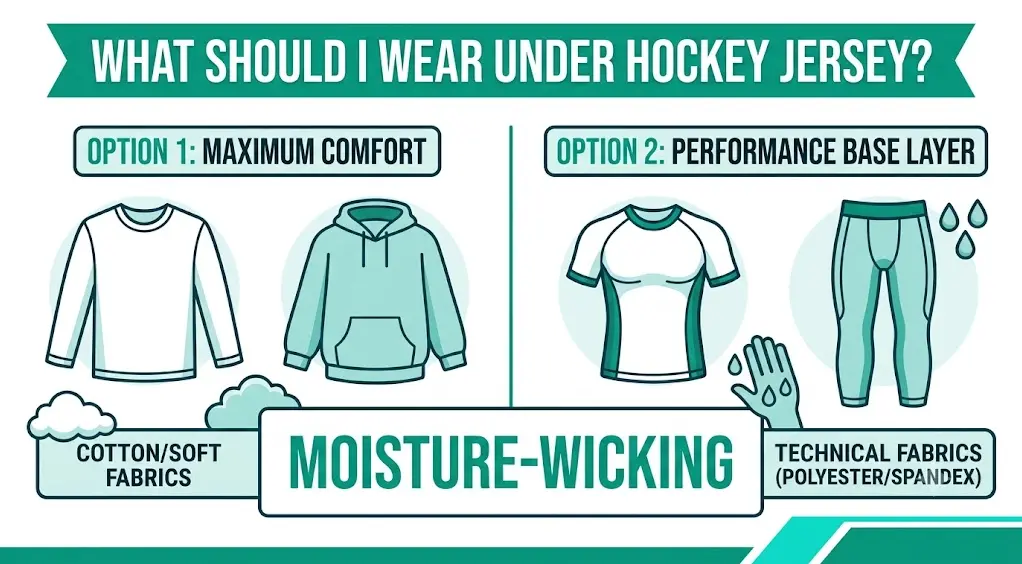
A hockey jersey is the outer layer, not the base layer. What sits underneath controls sweat, comfort, odor, protection, and how well the full kit moves.
The right setup is simple: moisture-wicking clothing, required protection, sock support, and gear that fits under the sweater without bunching.
Do not confuse fan outfit layering with what players wear on the ice. They are completely different problems.
Start with a moisture-wicking base layer
Synthetic performance fabric or merino works better than cotton because it moves sweat away from the body. Cotton gets heavy, holds moisture, and makes cold rinks feel colder.
A fitted long-sleeve top and compression-style bottom are common choices.
Use this quick checklist before moving forward:
- Moisture-wicking top: Keeps sweat away from skin.
- Compression or performance bottom: Reduces bunching under gear.
- Jock or jill with sock tabs: Holds hockey socks in place.
- Thin skate socks: Protects boot fit.
- Neck guard if required: Check league rules.
- Hockey socks over shin guards: That is where team socks belong.
Wear the protective pieces in the right order
The jock or jill usually goes over the base bottom and helps hold hockey socks with Velcro tabs. Hockey socks cover the shin guards, not the foot like normal socks.
Skate socks should be thin enough to keep the boot fit precise.
Check league safety requirements
Some leagues require neck protection or other specific gear. Parents and adult beginners should confirm local rules before assuming a base outfit is complete.
Comfort matters, but compliance comes first.
For casual wear, treat it differently
If you are styling a fan jersey off ice, a hoodie or T-shirt is fine. That has nothing to do with the gear stack used for actual play.
Keep the two use cases separate when buying sizes.
Why cotton causes problems
Cotton feels comfortable at first, then holds sweat and gets heavy. In a cold rink, that moisture can make the player feel chilled between shifts.
Performance base layers are not just a premium upgrade. They solve a real comfort problem.
Here is Something for you, Our Complete Line of Custom Made Sublimated Hockey Uniforms .
Keep the lower body organized
The base bottom, jock or jill, shin guards, and hockey socks all work together. If one piece bunches, the whole lower-body setup feels wrong.
Thin skate socks also help keep the boot fit consistent.
Separate new-player advice from fanwear advice
A beginner asking about under-jersey layers usually needs equipment guidance. A fan asking about a game-day outfit needs styling advice.
The article should answer both briefly, but make the on-ice setup the priority.
Details worth verifying before you order
This is where a generic article usually stays vague. A real team buyer should check the operational details that affect price, timing, fit, and whether the finished jersey matches the proof.
Use these checks to turn the article advice into a cleaner purchase:
- Base top check: Moves sweat and reduces chafing. Before approval, use this as a real order checkpoint: cotton shirt.
- Jock/jill check: Protection and sock support. Before approval, use this as a real order checkpoint: loose casual shorts only.
- Skate socks check: Boot fit and moisture control. Before approval, use this as a real order checkpoint: thick bunchy socks.
- Neck guard check: Rule/safety requirement. Before approval, use this as a real order checkpoint: skipping local rules.
Common mistakes to avoid
Most new-player layering mistakes happen because comfort, protection, and sweat control are treated as separate problems.
- Wearing cotton: It holds sweat and gets cold between shifts.
- Using thick skate socks: They can change boot fit and create pressure points.
- Skipping local rules: Some leagues require specific protection such as neck guards.
- Mixing fanwear advice with gear advice: A hoodie outfit is not an on-ice setup.
A practical gear-layer workflow
Start closest to the skin. Choose a sweat-managing base, add required protective pieces, secure hockey socks, then put the jersey over the completed gear stack.
Before buying extras, test the full gear stack. The right base layer should disappear under the pads instead of bunching, overheating, or holding sweat.
Layering Guide
| Layer | On-ice purpose | Avoid |
| Base top | Moves sweat and reduces chafing | Cotton shirt |
| Jock/jill | Protection and sock support | Loose casual shorts only |
| Skate socks | Boot fit and moisture control | Thick bunchy socks |
| Neck guard | Rule/safety requirement | Skipping local rules |
Pro tip: If your base layer is soaked and heavy after warmups, switch fabrics. Cotton is usually the problem.
Conclusion
Under-jersey layers should manage sweat, hold protective gear, and keep movement clean. For actual play, choose performance fabric and required protection before thinking about style. Use it as the final checkpoint before approving a custom order.
FAQs
Can I wear a hoodie under hockey gear?
For on-ice play, it usually bunches under pads. Hoodies are better for casual fan outfits.
Should I wear cotton under hockey pads?
No. Cotton holds moisture and gets heavy. Use performance fabric or merino instead.
Do hockey socks go under or over shin guards?
They go over shin guards and are often held up by Velcro tabs on a jock or jill.