
Hockey Jersey Size 50 Equivalent: What It Means Across Brands
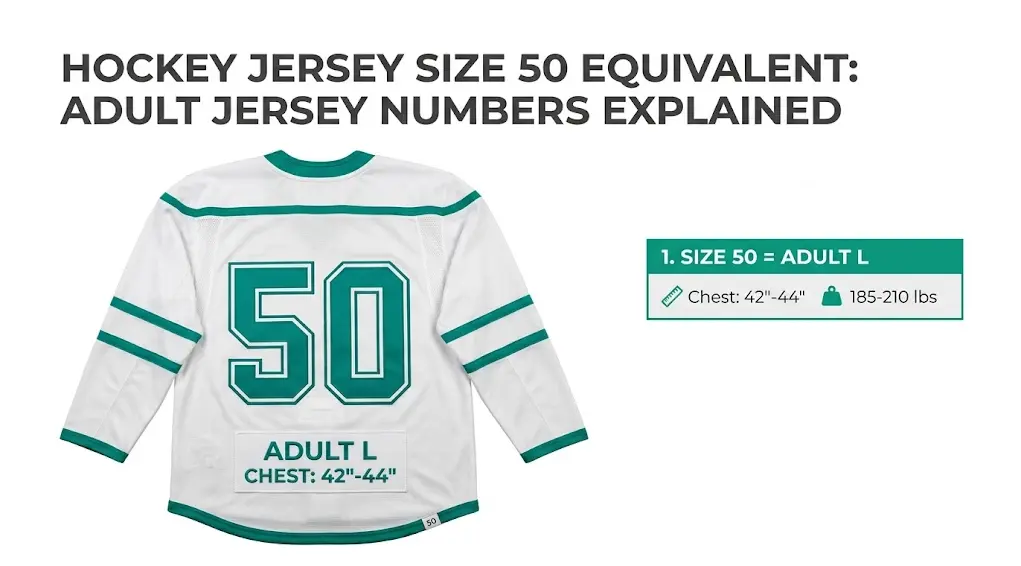
Size 50 is where hockey sizing gets annoying. One chart may treat it like a Large, while another older or specialty chart may place it closer to a Medium.
That is why the best answer is not a single label. You need the garment measurements and the jersey line.
Use size 50 as a starting point, then check the exact chart before buying or adding it to a team roster.
The short answer
On many modern fanwear charts, 50 lines up around a Large. On some numbered hockey charts, 50 may be shown closer to Medium. That conflict is normal because sizing systems are not universal.
The safer comparison is chest width, body length, and sleeve length.
Use this quick checklist before moving forward:
- Do not rely on Medium/Large alone: Labels differ by brand and product line.
- Check the exact brand chart: The product-specific chart should win.
- Compare garment chest: Measurements beat label guesses.
- Consider hoodie or pad layering: Different layers need different room.
- Separate fanwear from game use: Retail fit and equipment fit are different.
Why charts disagree
Authentic, replica, practice, custom, and fan jerseys are cut for different use cases. Some are meant for pads. Some are meant for streetwear. Some are built around licensed retail sizing.
A number alone cannot tell you the whole fit.
For wearing over pads
If the jersey will be used on ice, compare against a piece that already fits over shoulder and elbow pads. A fanwear Large may not behave like a team game cut.
When in doubt, ask the supplier for flat garment dimensions.
See Our Brilliantly Sublimated Custom Designed Hockey Jerseys
For casual outfits
For off-ice wear, decide whether it goes over a T-shirt or hoodie. Hoodie layering usually needs more chest and sleeve room than a simple fan outfit.
That is a styling choice, not a playing-equipment choice.
Use measurements to settle the Medium-versus-Large debate
When size labels conflict, chest and length measurements settle the argument. A garment chest around the mid-40s may feel different depending on whether it is cut for fanwear or equipment.
If the buyer only knows normal shirt size, size 50 should be treated as a test point, not a guarantee.
Fanwear and teamwear are not the same fit problem
A fan jersey is often worn over a T-shirt or hoodie. A team jersey has to clear pads and movement. Those two jobs need different space.
That is why one person can like a size 50 off ice and still need another size for play.
What to do if you are between sizes
For casual wear, choose based on the layer underneath. For on-ice use, choose based on pad clearance and sleeve movement.
If the chart gives exact garment measurements, compare them with a jersey you already like.
Details worth verifying before you order
This is where a generic article usually stays vague. A real team buyer should check the operational details that affect price, timing, fit, and whether the finished jersey matches the proof.
Use these checks to turn the article advice into a cleaner purchase:
- Fan jersey check: Medium or Large?. Before approval, use this as a real order checkpoint: check the brand chart.
- Over hoodie check: Enough chest room?. Before approval, use this as a real order checkpoint: compare garment width.
- Over pads check: Enough shoulder/sleeve room?. Before approval, use this as a real order checkpoint: use equipment fit test.
- Custom team order check: Will all brands match?. Before approval, use this as a real order checkpoint: use supplier-specific chart.
Common mistakes to avoid
Most sizing problems come from treating a hockey top like normal clothing. Equipment, cut, and product chart differences matter more than the label.
- Using shirt size only: A streetwear size does not account for shoulder pads, elbow pads, or goalie equipment.
- Mixing brand charts: Use the chart for the actual product, not a similar jersey from another supplier.
- Forgetting sleeve movement: A jersey can look long enough but still restrict the elbow area.
- Guessing for youth players: Kids need a gear-on check because growth and pad size vary widely.
A practical sizing workflow
Start with the product chart, then compare it against a jersey that already works over equipment. If the order is for a team, collect sizes in one sheet and flag players who are between sizes or wearing goalie gear.
Before final approval, scan the roster for patterns. If half the team sized up because of pads and one player did not, ask why. That small check catches the sizing outlier before production.
Size 50 Buying Logic
| Use case | Likely fit question | Best move |
| Fan jersey | Medium or Large? | Check the brand chart |
| Over hoodie | Enough chest room? | Compare garment width |
| Over pads | Enough shoulder/sleeve room? | Use equipment fit test |
| Custom team order | Will all brands match? | Use supplier-specific chart |
Pro tip: When two charts disagree, trust the chart tied to the product you are actually buying.
Conclusion
Size 50 is usually around Medium-to-Large territory, but the product line decides the real fit. Use measurements, layering plans, and the exact chart before making the final call.
FAQs
Is size 50 a medium or large hockey jersey?
It depends on the chart. Many fanwear charts place it near Large, while some numbered charts show it closer to Medium.
Is NHL size 50 the same as Fanatics size 50?
Not always. Licensed lines and product styles can use different measurements.
Should I buy size 50 to wear over a hoodie?
Only if the chest and sleeve measurements give enough room for the hoodie underneath.