
Why Are Hockey Jerseys So Expensive? The Real Cost Drivers
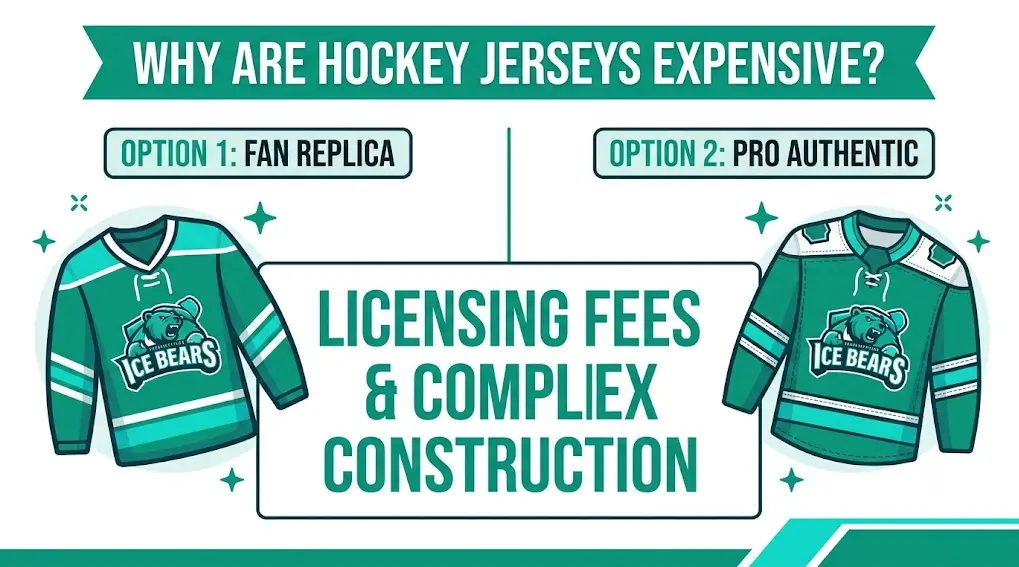
A hockey jersey is not priced like a blank T-shirt because it is not built like one. Fabric weight, decoration, licensing, personalization, and production setup all change the cost.
For custom teams, the price only makes sense when you know what is included.
The cheapest quote is not always the cheapest finished order, especially if names, numbers, socks, reorders, or rush timing are separate.
Fabric and construction raise the baseline
Hockey jerseys need room for pads, sleeve volume, and stronger wear zones than a casual shirt. Heavier mesh, reinforced shoulders, double elbows, or goalie cuts all add cost.
A flimsy jersey may look fine once, then fail after real play and repeated washing.
Use this quick checklist before moving forward:
- Fabric weight: Heavier builds usually cost more.
- Decoration method: Sublimation and twill price differently.
- Names and numbers: Confirm whether they are included.
- Minimum order: Affects per-piece cost and reorders.
- Turnaround time: Rush timing can change the quote.
- Licensed branding: Retail fanwear has licensing costs.
Decoration changes the labor
Sublimation can include complex graphics, names, and numbers efficiently because the design is built into the fabric. Tackle twill takes more labor and gives a heavier stitched look.
Neither is automatically better. They solve different buyer problems.
Custom orders have setup costs
Artwork cleanup, mockups, proofs, roster handling, color matching, and production setup all take time before the first jersey is made.
That is why minimums matter. A one-off order spreads setup cost over one piece, while a team order spreads it across the roster.
Licensed fanwear has a different price logic
NHL-style retail jerseys include brand licensing, official team marks, retail distribution, and product-line differences between replica and authentic versions.
Those costs are separate from a custom team supplier’s pricing.
Cheap quotes can hide missing pieces
A low price may exclude names, numbers, design work, socks, shipping, or later reorders. Those costs show up after the team has already compared the wrong number.
Ask for an itemized quote so every supplier is being judged on the same package.
Here is Something for you, Our Sublimated Hockey Uniforms That are Custom Made.
Personalization is real production work
Every player name and number has to be placed, checked, and produced correctly. Even with sublimation, roster data still needs careful handling.
That labor is invisible when the order goes well, but very visible when it goes wrong.
Value is about use, not just price
A jersey for one charity game can be simpler than a jersey for weekly league play. A youth program with reorders needs different value than a one-night event.
The right price is the one that fits the real use case.
Details worth verifying before you order
This is where a generic article usually stays vague. A real team buyer should check the operational details that affect price, timing, fit, and whether the finished jersey matches the proof.
Use these checks to turn the article advice into a cleaner purchase:
- Fabric check: Durability and feel. Before approval, use this as a real order checkpoint: ask weight/content.
- Decoration check: Look and labor. Before approval, use this as a real order checkpoint: compare sublimation vs twill.
- Roster check: Personalization workload. Before approval, use this as a real order checkpoint: submit clean data.
- Turnaround check: Rush fees and scheduling. Before approval, use this as a real order checkpoint: order earlier.
Common mistakes to avoid
Most price mistakes happen when buyers compare per-piece numbers without checking what the quote includes.
- Comparing incomplete quotes: Names, numbers, socks, shipping, and reorders can change the real total.
- Ignoring setup work: Artwork, proofs, and roster handling take production time.
- Choosing the cheapest fabric: Low durability can cost more in replacements.
- Ordering too late: Rush timing can erase the savings from a low quote.
A practical quote-comparison workflow
Start with an itemized quote. Compare fabric, decoration, names, numbers, socks, proofing, shipping, turnaround, and reorder policy before choosing the supplier.
Before choosing the cheapest option, calculate the real finished cost. A quote that includes proofing and personalization may beat a lower price that adds everything later.
Common Cost Drivers
| Cost driver | What it affects | Buyer move |
| Fabric | Durability and feel | Ask weight/content |
| Decoration | Look and labor | Compare sublimation vs twill |
| Roster | Personalization workload | Submit clean data |
| Turnaround | Rush fees and scheduling | Order earlier |
Pro tip: Compare quotes by what is included, not just the headline price. Names, numbers, socks, and reorders can change the real cost.
Conclusion
Jersey cost comes from construction, decoration, setup, personalization, and licensing. A fair comparison looks at the full order, not just the lowest per-piece number. Use it as the final checkpoint before approving a custom order.
FAQs
Are sublimated hockey jerseys cheaper than tackle twill?
Often they are more efficient for full customization, but the final price depends on supplier, fabric, and order size.
Why do custom jerseys have minimums?
Minimums help spread setup, artwork, and production time across enough pieces.
Are authentic NHL jerseys worth more than replicas?
Authentic styles usually use higher-end construction and details, while replicas are built for lower-cost fanwear.