
Sublimation vs Embroidery: Which Is Right for Your Brand’s Apparel?
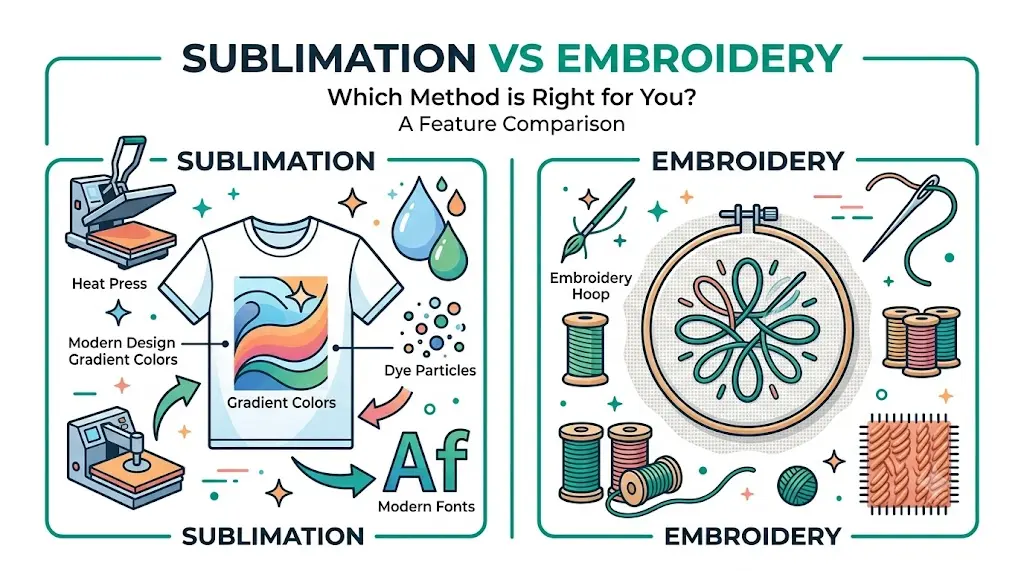
Embroidery stitches your logo into the garment with thread. Dye-sub prints it into the fibers with gas-phase ink. Choosing sublimation or embroidery isn’t about which looks better, it’s about what your garments are made of, how many you’re ordering, and what the design demands.
Get it wrong and you pay for it twice: once in unit cost, again in a uniform program that looks dated in a year. This guide gives you the real numbers, digitizing fees, stitch-count pricing, volume breakpoints, so you can decide in one read.
The Short Answer for Busy Buyers
Embroidery wins on structured, professional garments: polos, caps, jackets, anything where a raised, textured logo signals quality. It works on cotton, poly, canvas, and fleece alike, and it reads as premium at arm’s length.
Dye sublimation wins on performance apparel and bold graphics: jerseys, event tees, all-over patterns, photographic art. It needs 65%+ polyester in white or light colors, but delivers unlimited color at zero hand-feel, and the print never cracks, peels, or snags.
Most established brands don’t pick one. They run both, matched to the garment. We’ll show you how that mixed program works after the numbers.
How Embroidery Works (and What It Really Costs)
Embroidery starts with digitizing: a technician converts your logo into a stitch file that tells the machine every needle movement. That’s a one-time fee, typically $20–$100 depending on complexity, simple text logos land near $20, detailed crests closer to $100.
From there, pricing runs on stitch count. A standard left-chest logo uses 4,000–10,000 stitches; shops charge roughly $0.50–$4.00 per 1,000 stitches depending on volume and region. In practice, that small chest logo costs $2–$4 per garment on a decent-sized run.
Large designs escalate fast. A full jacket-back piece can hit 15,000–30,000 stitches and $8–$12 per unit, before the garment itself. Many shops also add a $5–$10 setup charge per design for thread changes and machine calibration.
- Digitizing: $20–$100, one-time. Reorders reuse the same file free.
- Left-chest logo: $2–$4 per garment at volume, 4,000–10,000 stitches.
- Large back design: $8–$12 per garment, 15,000+ stitches.
- Setup: $5–$10 per design per run at many shops.
The math favors repeat orders. At 6 units, the digitizing fee alone adds $8–$17 per item. At 72+ units, it disappears into pennies. Embroidery is a commitment technology: expensive to start, cheap to rerun.
How Dye Sublimation Works (and Why It Prices Differently)
Sublimation prints your design onto transfer paper, then a heat press at 385–400°F for 45–60 seconds turns the solid dye to gas and drives it inside polyester fibers. Nothing sits on the fabric; the fabric itself changes color. Our sublimation printing guide covers the full process.
There’s no digitizing fee and no stitch count. Cost scales with print area and ink coverage, not design complexity. A photographic full-front print costs the same to press as a one-color logo of the same size, a pricing logic embroidery can’t touch.
The constraints are fabric-side: 65%+ polyester minimum, white or light garment colors, and no white ink in the system. In exchange, the print lasts the life of the garment because there’s no layer to crack or thread to snag.
Rule of thumb: if the design has more than 9 colors, a gradient, or a photo, embroidery is out. If the garment is dark cotton, dye-sub is out. Most decisions end right there.
Side-by-Side: What Each Method Delivers
| Factor | Embroidery | Dye sublimation |
| Look and feel | Raised, textured thread; premium at close range | Flat, zero hand-feel; part of the fabric |
| Durability | Decades; thread can snag or fray at edges | Life of the garment; cannot crack or peel |
| Cost at volume | $2–$12/unit by stitch count, plus digitizing | Drops steeply at volume; no per-color penalty |
| Garment compatibility | Cotton, poly, blends, canvas, fleece, any color | 65%+ polyester, white or light colors only |
| Design limits | 9–15 thread colors; no gradients or photos | Unlimited color, gradients, photos, all-over prints |
| Typical MOQ | 6–12 pieces at most shops | 1 piece for blanks; 20–50 for cut & sew |
Read the design-limits row twice. Thread is a physical medium, every color is a separate spool, and gradients must be faked with blended stitch directions. A sunset photo or a fade from teal to navy simply cannot be embroidered. Dyed gas has no such rule.
Where Embroidery Wins
Corporate and uniform apparel buyers keep choosing thread for good reasons. It survives industrial laundering, reads as established, and works on the structured garments professional programs are built around.
- Polos and button-downs: a stitched left-chest logo is the corporate standard, and pique cotton won’t take dye-sub anyway.
- Caps and beanies: curved, seamed surfaces press poorly but hoop beautifully.
- Outerwear and fleece: thick jackets and dark softshells are exactly where transfers struggle and thread shines.
- Heritage branding: law firms, banks, golf clubs, anywhere texture equals trust.
Where Dye-Sub Wins
Flip the garment to polyester performance wear or bold graphics, and the calculus reverses completely.
- Team jerseys: numbers, names, sponsor panels, and gradients in one press, with zero weight added to a breathable knit.
- All-over prints: seam-to-seam coverage via cut & sew panels, physically impossible with a hoop.
- Photo and art designs: continuous-tone images render exactly, no color-count ceiling.
- Event and promo tees: no digitizing fee means fast, cheap one-off designs per event.
There’s a comfort argument too. A 20,000-stitch back piece adds stiffness and a scratchy reverse side that needs backing fabric. On athletic wear, that’s disqualifying. A sublimated back panel weighs nothing because it is nothing, just recolored fiber.
Cost at Volume: A Worked Example
Say you’re ordering 100 pieces with a full-front design plus a small secondary mark. Here’s how the decoration cost alone plays out at typical mid-market rates.
| Scenario | Embroidery | Dye sublimation |
| Setup / digitizing | $60 one-time + $10 setup | $0 |
| Small logo, 100 pcs | $250–$400 | $150–$250 |
| Full-front design, 100 pcs | $800–$1,200 | $300–$500 |
| Reorder of 100 | Same per-unit, no digitizing | Same or lower |
The gap widens as the print grows. Embroidery prices punish area and detail; dye-sub barely notices them. But remember the fabric rule, if the program runs on cotton polos, the dye-sub column isn’t available at any price.
The Mixed Program: Why Smart Brands Use Both
Walk through any pro sports facility and you’ll see the answer: sublimated jerseys with embroidered crests on the polos, stitched caps next to printed warm-ups. Decoration follows the garment, not brand loyalty to one method.
A common corporate build: embroidered logos on staff polos and jackets, sublimated performance tees for field teams and events, and cut & sew AOP pieces for retail merch. One brand identity, three price points, each garment decorated the way it wears best.
Some garments even combine both, a sublimated all-over body with an embroidered chest crest stitched on after pressing. The flat print carries the design; the raised thread carries the brand. It’s the strongest look in team retail right now.
Pro tip: digitize your logo once, in vector and stitch-file form, before your first order. Every future supplier, thread or dye , can work from the same master files, and you’ll never pay setup twice.
How to Decide for Your Program
Run your order through three questions. What’s the fabric? Cotton or dark garments push you to thread. What’s the design? Photos, gradients, or all-over coverage push you to dye. What’s the reorder pattern? A logo you’ll rerun for years amortizes digitizing to nothing.
If you’re still split, order samples of both on your actual garments. Decoration that looks right on a screen can land differently on a pique polo versus a poly jersey, a $50 sample round is the cheapest insurance in apparel.
Ready to price a real order? Send us your logo, garment list, and quantities for a custom apparel bulk quote, we’ll spec embroidery, dye-sub, or a mixed program and show you the per-unit math side by side.
Conclusion
Embroidery suits structured cotton garments, small logos, and heritage branding; dye sublimation owns polyester, full-color graphics, and all-over designs. Match the method to each garment, digitize your logo once, and request a bulk quote to compare real per-unit pricing.
FAQs
Is embroidery more durable than a sublimated print?
They fail differently. Thread lasts decades but can snag, fray, or pucker after aggressive washing. A sublimated design can’t snag because it’s inside the fiber, it lasts as long as the fabric does. For industrial laundering, both hold up well.
Can you embroider polyester performance fabric?
Yes, with the right stabilizer and needle, though very thin knits can pucker around dense stitch areas. Many teams embroider a small crest on sublimated jerseys. Just keep stitch counts modest on lightweight poly.
Which is cheaper for a 500-piece order?
For a small logo, they’re close, often $2–$3 per unit either way once digitizing amortizes. For large or multicolor designs, dye-sub is usually 40–60% cheaper because embroidery pricing scales with stitch count and thread changes.
Can embroidery reproduce gradients or photographs?
No. Thread is a solid-color medium limited to the spools loaded on the machine, typically 9–15 colors. Gradient effects can be approximated with blended stitching, but photos and smooth fades require a printed method.