
Difference Between DTF and Sublimation: Which Is Better for Custom Apparel?
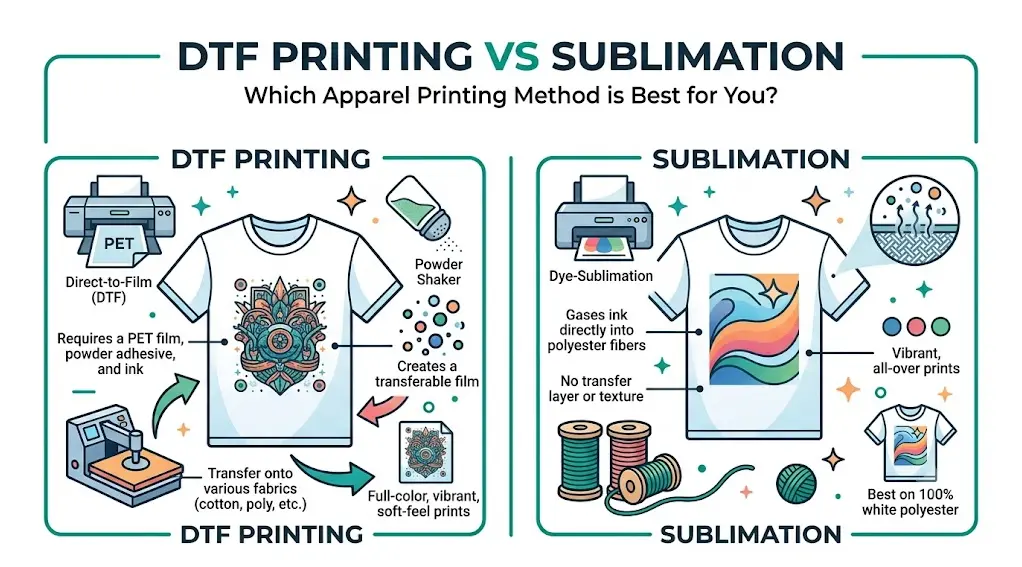
DTF printing glues a printed film onto the surface of a garment. Sublimation turns dye into gas and drives it inside polyester fibers. One sits on the shirt; the other becomes the shirt.
That single distinction decides which fabrics you can print, how long the design survives the wash, and what every unit costs you. If you’re choosing a method for a merch line, a team order, or your first press, this side-by-side breakdown gives you real numbers, not marketing claims, to decide with.
We’ll cover how each process works, where each one wins on quality, durability, cost, and speed, and finish with a decision table you can apply to your own order in about a minute.
The Core Distinction, Explained in 60 Seconds
Direct-to-film (DTF) is an adhesive technology. The design is printed onto PET film, dusted with hot-melt powder, and heat-pressed onto the garment, any garment, any color, as a thin bonded layer.
Dye-sub is a dyeing technology. Under roughly 400°F of heat, solid ink becomes gas and permanently recolors the polyester fibers themselves. Nothing is added on top of the fabric; the fabric itself changes.
Remember it this way: DTF is a sticker fused to the shirt. Dye-sub is a tattoo in the fibers.
The confusion between them is understandable. Both start at an inkjet printer, both end at a heat press, and suppliers often offer both from the same workshop. But everything in between, chemistry, fabric rules, durability, unit economics , runs on different physics.
How DTF Printing Works
- Print the design (plus a white ink layer) onto PET transfer film.
- Powder the wet print with hot-melt adhesive and cure it briefly.
- Press the film onto the garment at about 300–325°F for 10–15 seconds, then peel.
That white layer is the quiet hero of the process. It prints underneath the colors, so the design stays opaque no matter what shade the garment is, the trick no dye-based method can pull off.
Because DTF lays down its own white base, it prints bright, opaque designs on black cotton hoodies just as easily as on white tees. That fabric freedom is its biggest selling point.
The compromise is physical. A transfer film, however thin, sits on top of the weave. On small chest logos you’ll barely notice it; across a large back print, the panel can feel slightly plasticky and trap heat, something to sample before committing a whole line to it.
Cure quality also makes or breaks the product. Film pressed at the wrong temperature or peeled too early is exactly the kind of transfer that starts lifting at the edges after a dozen washes, and it’s where cheap suppliers cut corners.
How Dye Sublimation Works
- Print the design in mirror image onto coated transfer paper with dye-based inks.
- Press paper against the fabric at 385–400°F for 45–60 seconds.
- Cool the polyester pores close and lock the gaseous dye inside permanently.
The trade-off is strict: it needs white or light-colored fabric that’s at least 65% polyester. In exchange, you get color that cannot crack or peel, because there’s no layer to crack.
It’s also the only one of the two that can print a garment edge to edge. All-over-print apparel, leggings, jerseys, Hawaiian shirts, is made by sublimating fabric panels before sewing, a process no film-based method can replicate.
DTF vs Sublimation: Side-by-Side Comparison
| Factor | DTF | Dye sublimation |
| Fabrics | Cotton, poly, blends, canvas | 65%+ polyester only |
| Dark garments | Yes — built-in white ink layer | No — light colors only |
| Hand-feel | Thin film you can feel | Zero — fabric stays soft |
| Durability | 50–60 washes with proper care | Life of the garment |
| Cost per A4 print | $0.50–$1.50 | $0.30–$0.80 |
| Best order size | One-offs and small runs | Medium to bulk runs |
| Production speed | Fast — fewer steps | Slower — more prep at scale |
| Eco profile | PET film + powder waste | Water-based dyes, low waste |
Print Quality and Color
Both methods produce sharp, full-color output , the difference is in character. DTF prints are opaque and punchy, with the white underbase making colors pop even on black fabric.
Dye-sub prints are smooth and luminous, with gradients and photographic detail that melt into the fabric. Because there’s no underbase, colors interact with the garment: brilliant on white polyester, invisible on navy.
For fine text and hairline detail, DTF holds a slight edge on dark garments. For large photographic areas, skin tones, and seam-to-seam patterns, dye-sub is in a league of its own.
Durability: What Wash Tests Actually Show
Independent 50-wash tests keep reaching the same verdict. Well-cured DTF prints hold up for 50–60 washes before fine cracking appears, especially on stretched or heavily-worn garments.
Sublimated designs simply don’t degrade that way. The dye is part of the fiber, so the print fades only when the fabric itself wears out. For uniforms and workwear that get washed weekly, that gap compounds fast.
Stretch is the other stress test. Film transfers on leggings, sports bras, or anything worn tight develop micro-cracks along stretch lines first. Dyed fibers stretch with the garment because there’s nothing separate to break.
Do the math for a uniform program: at two washes a week, a DTF print hits its 50–60 wash lifespan in roughly six months. A sublimated jersey from the same order is still presentable when the team retires it.
Care matters: washing cold and inside-out roughly doubles the visible lifespan of any DTF transfer. Dye-sub needs no special treatment at all.
Cost: Per Print and at Volume
On consumables alone, dye-sub is the cheaper print: $0.30–$0.80 for a full-color A4 transfer versus $0.50–$1.50 for DTF once film and powder are counted.
Equipment flips the equation. DTF setups cost less to enter at the hobby level, while dye-sub’s economics improve the bigger the run, which is why high-volume apparel producers standardize on it for polyester goods.
Watch the hidden costs, too. DTF’s adhesive powder and film are recurring purchases that scale with every unit, and white ink is the most expensive ink in the bay, plus it clogs heads if the printer sits idle. Dye-sub’s recurring costs are lower, but wasted blanks cost more since the print can’t be removed once pressed.
Fabric Compatibility
This is usually the deciding factor. If your line runs on cotton, or anything dark, DTF is your only real option of the two. If you’re producing sportswear, jerseys, or all-over-print pieces on polyester, dye-sub delivers better results at a lower per-unit cost.
Blends behave predictably: the more polyester in the fabric, the more dye it holds. A 50/50 blend sublimated deliberately gives a soft, retro wash-out effect, a feature for some fashion lines, a defect for team uniforms.
Equipment and Startup Costs Compared
If you’re weighing which system to buy rather than which service to order from, the entry math looks like this:
| Item | DTF setup | Dye-sub setup |
| Printer | $1,500–$4,000 (dedicated DTF) | $400–$1,500 (desktop dye-sub) |
| Consumables to start | Film, powder, inks: $150–$300 | Paper, inks: $80–$150 |
| Heat press | $150–$500 | $150–$500 |
| Extras | Curing oven/shaker for volume | ICC profiles, poly blanks |
| Realistic entry total | $2,000–$5,000 | $700–$2,500 |
Desktop dye-sub is the cheaper door to walk through, which is why crafters flock to it. Serious DTF hardware costs more because of the white-ink system and film handling, budget “DTF conversion kits” for regular printers are where most horror stories start.
Speed and Scalability
Per single garment, DTF is quicker: print, powder, press, done, often under five minutes. That’s why on-demand shops love it.
At scale the picture reverses. Sublimation transfers can be printed on rolls by the hundreds and pressed in rapid sequence, and calendar presses handle entire fabric bolts. For a 500-piece polyester order, a dye-sub line will finish long before a single-press DTF workflow.
Feel, Comfort, and Breathability
Hold a sublimated jersey against a DTF-printed one and the difference is immediate. The dyed garment feels like plain fabric everywhere, because it is, moisture-wicking and airflow work exactly as the textile intended.
The film print blocks both where it covers. For a small logo that’s irrelevant; for athletic wear or all-over designs, it’s the difference between a shirt people wear to train in and one they leave in the drawer.
Print-on-Demand vs Wholesale Production
The two methods also map onto two business models. Print-on-demand platforms lean on DTF and DTG because every order is a batch of one, and per-unit speed is everything.
Wholesale production flips the priorities: color consistency across hundreds of units, per-unit cost, and durability guarantees. That’s dye-sub territory, and it’s why bulk apparel manufacturers quote noticeably lower per-shirt prices than POD platforms for the same polyester garment.
What About UV DTF and Other Variants?
You’ll also see UV DTF advertised, a cousin technology that cures ink with ultraviolet light and sticks to hard surfaces like bottles and glass. It’s not for fabric at all, so don’t let a supplier sell it to you for apparel. We compare it separately in our UV DTF guide.
Heat transfer vinyl (HTV) gets confused with both methods as well. It’s a cut sheet of colored vinyl, not a printed image, fine for names and numbers, wrong for artwork. We break down that comparison in a separate guide too.
Which Should You Choose? A Decision Guide by Use Case
| Your project | Better method | Why |
| Corporate merch on dark cotton | DTF | White ink layer works on any color |
| Team jerseys & activewear | Sublimation | Breathable, permanent, no peeling |
| All-over-print fashion line | Sublimation | Seam-to-seam coverage, zero feel |
| One-off samples & tiny runs | DTF | Minimal setup, fast turnaround |
| Bulk polyester uniform program | Sublimation | Lowest cost per unit at volume |
Plenty of brands end up using both: dye-sub for their polyester performance range, DTF for dark cotton streetwear. The mistake is forcing one method to do the other’s job.
Three Real Orders, Three Right Answers
- A gym ordering 300 branded training shirts: polyester fabric, weekly industrial washing, logo plus sponsor panel. Dye-sub, without hesitation, the prints must outlive the membership cards.
- A coffee brand printing 40 black hoodies for a launch event: dark cotton, small quantity, needed in ten days. DTF is the only sensible answer here.
- A fashion startup building an all-over-print resort line: seam-to-seam artwork on flowy polyester. Cut-and-sew dye-sub production, DTF physically can’t produce this garment.
Notice that in all three cases, the fabric and the wash schedule made the decision. Budget only broke ties.
Three questions settle it in under a minute:
- What’s the fabric? Cotton or dark garments point to DTF. Light polyester points to dye-sub.
- How big is the print? Chest logo, either works. Edge-to-edge coverage, dye-sub only.
- How many units, how often? One-offs favor DTF’s speed. Recurring bulk runs favor dye-sub’s per-unit economics and durability.
Ordering at volume? Send your design and quantities to a wholesale apparel supplier and ask them to quote both methods. A good supplier will tell you honestly which one fits your fabric and budget, before you spend a cent on equipment.
Four Misconceptions That Cost Buyers Money
- “They’re basically the same thing.” They share a heat press and nothing else. Ordering the wrong one for your fabric means a box of unsellable shirts.
- “Sublimation works on any shirt if you press hard enough.” No pressure setting makes cotton hold the dye. It will look fine out of the press and fade within five washes.
- “DTF is just as durable.” It’s durable enough for fashion wear, but it is a surface layer. For garments washed constantly, the difference shows up within months.
- “The cheaper quote is the better deal.” A suspiciously cheap DTF quote usually means rushed curing, the number-one cause of transfers that peel at the edges.
Questions to Ask Any Supplier Before You Order
Whichever method your order needs, five questions separate professional suppliers from resellers with a heat press in the garage:
- Which method will you use for my fabric, and why? A confident, specific answer is the best quality signal you’ll get.
- Can I see a washed sample, not a fresh one? Anything looks good straight off the press.
- What’s your polyester percentage on the blanks you quote? Below 65%, sublimated colors won’t hold.
- How do you guarantee color consistency across sizes and reorders?
- What’s the per-unit price at my quantity, and at double it? The break points tell you how their production actually scales.
Conclusion
DTF bonds a printed film onto any fabric, light or dark; dye-sub permanently colors polyester fibers themselves. Choose DTF for cotton and small runs, sublimation for polyester, all-over prints, and bulk orders where durability and per-unit cost decide the winner.
FAQs
Is DTF the same as sublimation?
No. They’re entirely different technologies, one adheres a film to the surface, the other dyes the fibers. They just happen to share a heat press, which is where most of the confusion comes from.
Which is better, DTF or sublimation?
Neither wins outright. DTF is better for cotton, dark garments, and one-offs. Dye-sub is better for polyester, all-over prints, and volume orders where longevity matters. Start from your fabric and the choice usually makes itself.
Which lasts longer in the wash?
Sublimated prints, and it isn’t close. DTF survives roughly 50–60 careful washes before wear shows; a dyed polyester fiber holds its color for the garment’s entire life.
Can you use a sublimation printer for DTF?
Not as-is, DTF needs different inks, white ink capability, and PET film. Some printers can be converted, but it’s rarely worth the hassle for production work.
Is sublimation cheaper than DTF?
Per print, usually yes ($0.30–$0.80 vs $0.50–$1.50 per A4 transfer). Per setup, no, DTF equipment is cheaper to start with. At bulk volumes, dye-sub’s per-unit advantage takes over.