
Sublimation Hoodie Blanks: Buying Guide for Bulk & Wholesale Orders
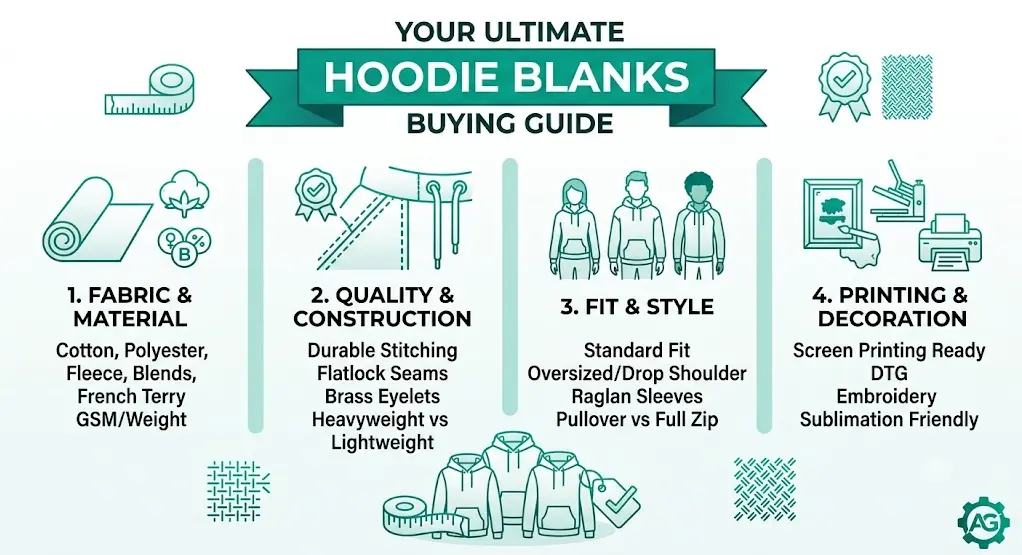
A hoodie is the highest-margin garment most print shops sell, and the easiest one to get wrong at the sourcing stage. The right hoodie blanks for sublimation press bright, wash clean, and feel like retail. The wrong ones ghost, fade, and come back as returns.
Buying in bulk raises the stakes. A bad single blank costs you $12; a bad case of 200 costs you a season. This guide covers exactly what to check, fiber content, fleece weight, construction, before you commit to a wholesale order.
What Makes a Hoodie Blank Sublimation-Ready
Three specs decide everything, and they’re all on the supplier’s product sheet if you know where to look.
Polyester content. Dye-sub ink only bonds with polyester, so the printable face must be 100% poly for full vibrancy, 65% is the practical floor, but expect a faded, vintage cast below 90%. Many blanks cheat smartly: a 100% poly outer face with a cotton-feel interior.
Color. There’s no white ink in sublimation, so the fabric supplies every light tone in your design. White blanks are the default; ash, cream, and pale heather work if your art accounts for the tint. Black and navy blanks are unprintable.
Surface finish. A smooth, tightly knit face prints sharper than a textured one. Brushed or spun-poly faces mimic cotton hand-feel and still press well, that soft face is exactly why customers can’t tell a good poly hoodie from a cotton one.
Fleece Weight: What GSM Actually Means for Your Order
Fleece weight is measured in grams per square meter, and it’s the spec that separates a promo-grade hoodie from a retail-grade one. Most poly hoodie blanks land between 240 and 320 GSM, roughly 7 to 9.5 ounces per square yard.
- 200–240 GSM: lightweight, promo and warm-climate territory. Cheapest per unit, thinnest feel.
- 250–300 GSM: the retail sweet spot, around 10 oz spun fleece. Substantial without being heavy.
- 300+ GSM: heavyweight, streetwear-grade. Costs more and presses slower, but commands premium pricing.
Weight also affects your press schedule. Heavier fleece holds more moisture, so pre-press for 5–8 seconds to drive it out before laying the transfer. Skip that step on a 300 GSM blank and you’ll see splotchy, undersaturated color.
Rule of thumb: if the blank costs less than a fast-food lunch, the fleece is under 240 GSM. Price your finished hoodie off the blank’s weight, not its wholesale invoice.
AOP Hoodies vs Pressing Blanks: Two Ways to Sell a Sublimated Hoodie
There are two routes to a full-color hoodie, and they serve different orders. Pressing blanks means buying finished hoodies and heat-pressing designs onto the front, back, or sleeves, fast, low minimum, perfect for logo work and small runs.
All-over-print hoodies are built the other way around: fabric panels get sublimated first, then cut and sewn into the garment. That’s how seam-to-seam coverage happens, and it’s the only route to edge-to-edge patterns. Our what is a sublimated hoodie guide breaks down the construction in detail.
For bulk buyers the decision is mostly volume math. Pressing blanks wins under about 50 units per design; cut & sew AOP wins when you need full coverage and can meet a factory minimum. Plenty of brands run both, AOP for hero products, pressed blanks for drops.
Bulk Buying Quality Checklist
Order one sample case before committing to volume, and run every blank through this list. Five minutes of checking beats a month of warranty emails.
- Fiber verification: press a test square at 400°F, true poly takes dye vividly; blends ghost immediately.
- Consistent sizing: measure chest width across 5 units from the case; more than 1 inch of variance means loose factory tolerances.
- Flat seams and low-profile pockets: bulky seams block transfer contact and cause white gaps.
- Hood and drawcord: poly drawcords survive the press; waxed cotton ones scorch.
- Stitching color: white poly thread stays white after pressing, bonus if the supplier uses sublimatable thread.
- Wash test: press one, wash it five times cold, and compare against an unwashed twin before you reorder.
One more sourcing call: pullover or zip-up. Pullovers give you an unbroken front canvas and press faster. Zip-ups split the front print down the middle and add metal hardware that can scorch or mark under the platen, stock them for embroidery-style chest logos, not big front graphics.
Wholesale Pricing Tiers: What Bulk Discounts Look Like
Every supplier structures tiers differently, but the shape of the curve is consistent across the market. Here’s an illustrative pricing ladder for a mid-weight (280 GSM) white poly hoodie blank.
| Order quantity | Typical price per blank | Discount vs single | Best for |
| 1–11 pieces | $14–$18 | — | Sampling and testing |
| 12–49 pieces | $11–$14 | 15–20% | Small shop restocks |
| 50–199 pieces | $9–$12 | 25–35% | Steady production runs |
| 200–499 pieces | $8–$10 | 35–45% | Wholesale resellers |
| 500+ / case-lot | $6.50–$9 | 45–55% | Contract and private label |
Two negotiating levers matter beyond quantity: committing to a single colorway (white) and accepting mixed-size case packs. Both simplify the supplier’s picking, and both routinely unlock another few percent off.
White Creasing: The Seam and Pocket Problem
Hoodies are the hardest garment in dye-sub because of their geometry. Anywhere fabric folds or lifts away from the platen, side seams, armpits, pocket edges, around the hood, the transfer can’t make contact, and you get unprinted white lines.
On pressed blanks, manage it by keeping designs inside flat zones: chest, upper back, sleeves. Full-bleed attempts on a finished hoodie will crease, guaranteed. Thread the pocket onto a press pillow if you’re printing near it, and accept that seams stay white.
On AOP hoodies, creasing risk moves to the factory. Better manufacturers print panels before sewing, which eliminates it entirely, another reason edge-to-edge designs belong in cut & sew production, not on your press.
Care Instructions to Pass On to Your Customers
Sublimated color is permanent, but the garment still deserves sane care. Include these on your hang tags, they protect the fleece, not the print.
- Machine wash cold, inside out, with like colors.
- Skip bleach and fabric softener; both dull the fleece face over time.
- Tumble dry low or hang dry to protect the brushed interior.
- Iron low, inside out, never directly on printed panels, reheating above 350°F can re-gas the dye.
Ready to Stock Up?
Browse our wholesale hoodie blanks collection for press-ready poly fleece in the weights and colorways above, with tiered case pricing built in. Running a bigger program or a private-label line? Send your quantities for a bulk quote and we’ll price it within one business day.
Conclusion
Buy hoodie blanks on three specs: 100% polyester face, 250–300 GSM fleece, white or light colors. Sample a case, run the quality checklist, and match pressed blanks or AOP to your volume. Then lock in tier pricing with a bulk quote.
FAQs
What is a sublimation blank hoodie made of?
The printable face is 100% polyester, the only fiber dye-sub ink bonds with permanently. Better blanks pair that poly face with a brushed or cotton-blend interior for softness, since the inside never gets printed.
Can you sublimate a 50/50 cotton-poly hoodie?
You can press it, but only the polyester half holds dye, so the design washes out to a faded, vintage look at roughly half saturation. For bright, retail-grade color, stay at 90–100% poly on the printing surface.
What GSM is best for a bulk hoodie order?
250–300 GSM covers most retail use cases, substantial hand-feel without heavyweight pricing. Drop to 200–240 GSM for promo giveaways and warm climates; go 300+ only when your brand positioning supports a premium price.
Why do all-over-print hoodies show white lines at the seams?
Those lines mean the hoodie was pressed after sewing, folds near seams blocked the transfer. Factory-made AOP hoodies avoid it by printing fabric panels first, then cutting and sewing, so ask your supplier which method they use.