
What Are Hockey Jerseys Called? Jersey, Sweater, or Uniform?
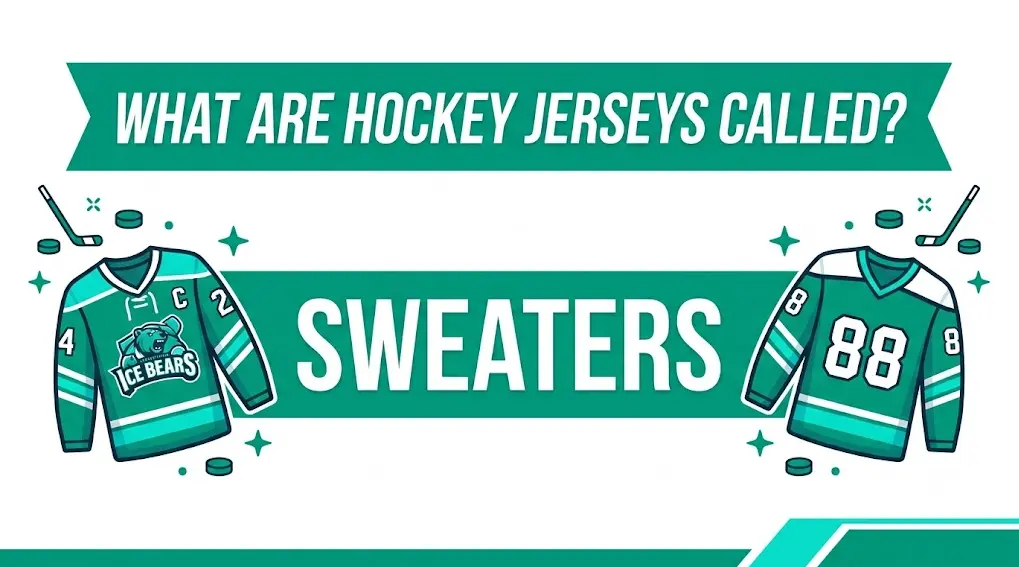
Hockey has two common words for the same upper-body garment: jersey and sweater. Both are understood, but they carry slightly different history and buying context.
If you are ordering custom gear, the term you use can also change what people think is included.
The short answer is easy. The useful answer explains when to say jersey, when to say sweater, and when to say uniform.
The short answer
Most buyers and suppliers say jersey. Many hockey people, especially in traditional contexts, still say sweater. Both point to the top worn over the player’s equipment.
Uniform usually means the broader kit, which can include jersey, socks, shells, and related team apparel.
Use this quick checklist before moving forward:
- Jersey for ordering: This is the clearest supplier term.
- Sweater for traditional hockey wording: Common among longtime hockey people.
- Uniform for the full kit: Use it when socks and extras are included.
- Socks as a separate item: They cover shin guards and complete the kit.
- C/A letters as jersey details: Leadership marks belong on the top.
Why hockey people say sweater
The older term comes from the heavier knit garments associated with the sport’s history. Modern pieces are usually synthetic performance fabrics, but the word stuck.
That is why rule references and longtime fans may still use sweater naturally.
What term to use with a supplier
Use jersey when requesting a quote, mockup, size chart, or reorder. It is the clearest commercial term and matches most product pages.
Use uniform if you want the complete package, including socks or additional apparel.
Here is Something Exclusively Made for you, Our Sublimated Hockey Uniforms That are Custom Made.
Do not confuse terminology with construction
Calling it a sweater does not mean it is made from wool or knit fabric today. Modern teamwear is usually polyester-based and designed for decoration, movement, and washing.
The word is cultural; the garment is technical.
Use the right word for the job
A fan article can use sweater because it sounds natural in hockey culture. An order form should usually use jersey because that is the clearest product term.
A quote request should use uniform only when the team wants more than the top.
Why the old word still matters
The sport keeps its language. Even though modern pieces are usually polyester, players and broadcasters still use traditional terms.
That history is part of the identity, especially in Canadian hockey conversations.
Ordering language should be specific
If you need matching socks, say so. If you need captain letters, sleeve numbers, or goalie cuts, list them separately.
The word uniform is too broad unless you define exactly what is included.
Details worth verifying before you order
This is where a generic article usually stays vague. A real team buyer should check the operational details that affect price, timing, fit, and whether the finished jersey matches the proof.
Use these checks to turn the article advice into a cleaner purchase:
- Jersey check: Ordering and retail. Before approval, use this as a real order checkpoint: upper-body team garment.
- Sweater check: Traditional hockey wording. Before approval, use this as a real order checkpoint: same garment, old-school term.
- Uniform check: Full team kit. Before approval, use this as a real order checkpoint: jersey plus related pieces.
- Socks check: Separate uniform item. Before approval, use this as a real order checkpoint: covers shin guards.
Common mistakes to avoid
Most terminology confusion happens when people use broad hockey words without defining what is actually included in the order.
- Using uniform too loosely: Say exactly whether socks, shells, or extras are included.
- Assuming sweater means knit fabric: Modern pieces are usually performance synthetics.
- Leaving out leadership marks: C/A letters are separate details that should be listed.
- Not naming the top clearly: Jersey is usually the cleanest ordering term.
A practical ordering-language workflow
Start by naming the exact item. If you need only the top, say jersey. If you need socks or extras, describe the full package instead of assuming the word uniform explains it.
Before requesting a quote, list every included piece. Clear language prevents a supplier from quoting only the top when the team expected a complete kit.
Hockey Term Guide
| Term | Best use | Means |
| Jersey | Ordering and retail | Upper-body team garment |
| Sweater | Traditional hockey wording | Same garment, old-school term |
| Uniform | Full team kit | Jersey plus related pieces |
| Socks | Separate uniform item | Covers shin guards |
Pro tip: When ordering custom gear, say jersey for the top and uniform package if you also need socks or other matching pieces.
Conclusion
Jersey and sweater usually refer to the same hockey garment, while uniform describes the larger kit. Use the term that matches the situation, especially when ordering custom pieces. Use it as the final checkpoint before approving a custom order.
FAQs
Why is a hockey jersey called a sweater?
The term comes from older hockey garments and remains part of the sport’s traditional language.
Do NHL players wear jerseys or sweaters?
Both words are used, though jersey is common in retail and sweater is common in traditional hockey speech.
Is a hockey uniform only the jersey?
No. A uniform can include the jersey, socks, and other matching team pieces.