
UV DTF vs Sublimation: Differences, Uses & Which to Choose
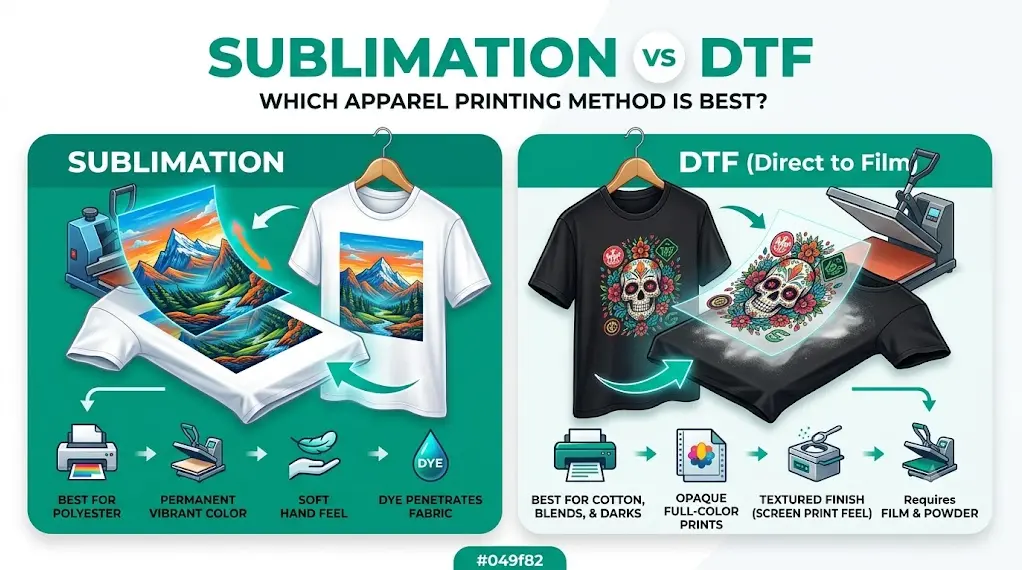
These two methods get compared constantly, but UV DTF and dye sublimation barely compete. One makes peel-and-stick decals for hard surfaces like bottles and phone cases. The other permanently dyes polyester fabric.
The confusion comes from the name; UV DTF sounds like a cousin of the fabric-printing DTF you’d use on shirts. It isn’t. Choose it for apparel and you’ll end up with a stiff sticker on a stretchy garment.
Here’s what each method actually does, where each one belongs, and the one-line rule that settles the choice.
Two Technologies That Barely Overlap
The quickest way to separate them: UV DTF is an adhesive decal technology for rigid objects, applied cold with your thumb. Sublimation is a dye technology for polyester fabric, applied with a 400°F heat press.
They don’t share inks, equipment, surfaces, or use cases. The real decision isn’t which is better, it’s which one matches the product in front of you.
How UV DTF Works
A UV printer lays down UV-curable ink onto a film, and ultraviolet light hardens the ink instantly as it prints. A laminated adhesive layer goes on top, producing a finished transfer, essentially a premium, full-color sticker.
- No heat press needed: you peel the decal and rub it onto the surface by hand.
- Hard surfaces only: glass, metal, ceramic, plastic, wood, bottles, tumblers, phone cases, signage.
- Strong bond: waterproof and scratch-resistant once applied to a clean, rigid surface.
- Lifespan: roughly 2–3 years on handled drinkware, 5+ years on indoor décor.
The trade-off is texture and flexibility. The cured ink is a raised, slightly glossy layer. On a rigid tumbler that’s fine; on fabric it cracks the moment the material stretches or hits a hot wash cycle.
How Dye Sublimation Works
Sublimation goes the opposite direction: instead of adding a layer, it changes the material. Dye printed on transfer paper is pressed against polyester at 385–400°F for 45–60 seconds, turns to gas, and bonds inside the fibers.
The result has no thickness, no edge, and no feel, and it lasts the life of the garment because there’s nothing on the surface to peel. The requirements are strict, though: 65%+ polyester and white or light-colored fabric.
Side-by-Side Comparison
| Factor | UV DTF | Dye sublimation |
| Surfaces | Hard goods: glass, metal, ceramic, plastic, wood | Polyester fabric and poly-coated blanks |
| Process | UV-cured ink decal with adhesive backing | Gas dye bonds inside the fibers |
| Application | Peel and stick by hand, no heat press | Heat press at 385–400°F, 45–60 seconds |
| Durability | 2–5 years depending on handling | Life of the garment |
| Feel | Raised, glossy sticker layer | Zero, fabric stays soft |
| Apparel suitability | Poor, stiff, cracks with stretch and washing | Excellent, made for it |
Which One Should You Choose?
Let the product decide. Building a merch line of shirts, hoodies, jerseys, or team kits? That’s dye-sub territory, permanent color, soft hand, and unit costs that fall as volume rises.
Decorating tumblers, candles, glassware, or phone cases, especially curved or awkward shapes a press can’t clamp? UV DTF is the right tool, and the no-heat application makes it beginner-friendly.
Rule of thumb: if it goes through a washing machine, sublimate it. If it sits on a desk or shelf, UV DTF it.
And if your actual question is about printing fabric with film-based transfers, the method that handles cotton and dark garments, that’s standard DTF, and our DTF vs sublimation guide breaks that comparison down in full.
Ready to put permanent, full-color designs on garments? Browse our sublimation apparel catalog to see what dye-sub looks like done right.
Conclusion
UV DTF makes tough adhesive decals for hard goods; sublimation dyes designs permanently into polyester apparel. They solve different problems, so pick by product: stickers for bottles and cases, dye-sub for anything worn or washed. Get that match right and both methods perform brilliantly.
FAQs
Can you use UV DTF on shirts?
Technically it can stick, but it shouldn’t. The cured decal is rigid, sits on the surface, and cracks quickly under stretching and hot washes. Fabric belongs to sublimation, DTF, or vinyl.
Does UV DTF need a heat press?
No, that’s its signature advantage. The transfer applies cold: peel, position, rub down, and remove the top film. It works on curved and irregular objects no press could clamp.
How long do UV DTF decals last?
Expect around 2–3 years on drinkware that’s handled and washed regularly, and 5 years or more on indoor items. Hand-washing extends the life of decorated tumblers considerably.
Is UV DTF the same as regular DTF?
No. Regular DTF heat-presses an ink-and-adhesive film onto fabric and flexes with the garment. UV DTF is a cold-applied, UV-cured decal designed strictly for hard surfaces.