
Sublimation Printing on Socks: Guide for Custom & Bulk Orders
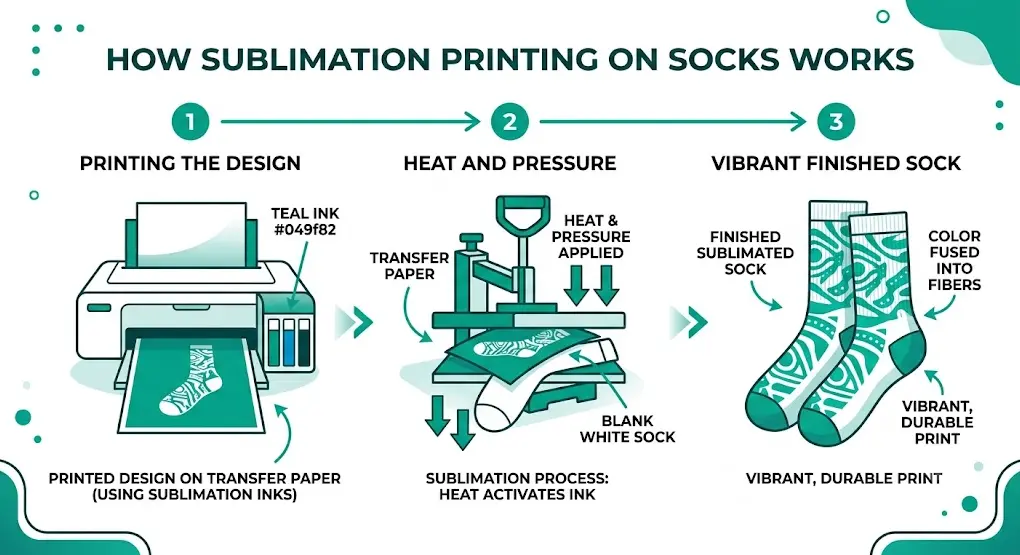
Custom socks have quietly become one of the highest-margin items in promotional apparel, and sublimated socks lead the category. The design is dyed into the fibers, wraps every curve of the foot, and never cracks, no matter how many times they’re washed.
But socks are also one of the trickiest blanks in the workshop. They’re small, tubular, stretchy, and full of seams. Get the setup right and you’ll press flawless pairs by the dozen. Get it wrong and you’ll waste half your blanks on ghosting and white creases.
This guide covers the blanks, the jig question, placement, the full pressing process, and what changes when you scale from one novelty pair to a thousand-pair corporate order.
Choosing Sock Blanks That Take the Dye
The fabric rule is non-negotiable. Sublimation dye only bonds with polyester, so a sock needs at least 65% poly content, and most purpose-made sock blanks run 85–100% polyester so colors come out at full saturation.
Cotton-heavy athletic socks are the classic beginner mistake. The dye sits loosely in the cotton, looks acceptable off the press, then washes out to a faded ghost within a cycle or two. Color matters too: the base must be white or very light.
Beyond fiber content, look at the knit. Smooth, flat-knit blanks print cleaner than heavily ribbed ones, because ribs open up when stretched and reveal undyed valleys.
- Crew socks: the bestseller for teams and merch, big leg panel, easy placement.
- Ankle and no-show: popular for gyms and running clubs; small print zone, so keep designs simple.
- Knee-high and tube: maximum canvas for all-over patterns and stripes; the go-to for game-day looks.
- Sizing: most blanks come in S/M/L or a stretchy one-size range, which simplifies bulk ordering enormously.
Sublimation Printing Socks: The Equipment That Makes It Work
The core kit is the same as any dye-sub job: a printer with sublimation ink, transfer paper, heat-resistant tape, and a heat press. The piece beginners miss is the sock jig.
A jig, sometimes sold as a sock insert or form, is a flat aluminum or hardboard shape cut like a foot and leg. You pull the sock over it so the knit sits slightly stretched, exactly the way it stretches on a real foot.
That stretch is the whole trick. Dye only reaches fibers the paper touches. Press a relaxed sock flat and the knit contracts afterward, exposing undyed white lines at every fold. On a jig, the dye lands on fibers already extended, so the finished pair looks solid when worn.
Pro tip: buy at least four jigs, not one. While one pair presses, you’re loading the next two, that alone can double your hourly output on bulk runs.
Design Placement: Foot Bed, Leg, and Seam Distortion
The leg panel is your safe zone. It’s flat, visible above the shoe, and knit consistently. Put logos, names, and numbers there roughly from the ankle bone to the cuff.
The foot bed is riskier real estate. It disappears inside a shoe, and heels and toes are often knit from a different, denser yarn that resists dye. Many blanks solve this with a plain white or colored foot; treat that as a feature, not a limitation.
Watch the toe seam. Artwork running across it distorts and prints unevenly, so end patterns just before the seam. And remember socks come in pairs: mirror the artwork so logos face outward on both feet.
Step-by-Step: How to Sublimate a Pair of Socks
- Print mirrored. Output the design in reverse on sublimation paper, sized to the stretched sock.
- Prep the blank. Lint-roll both socks and preheat each on the jig for about 10 seconds to drive out moisture.
- Load and tape. Pull the sock snug onto the jig, align the transfer face-down, and tape it so nothing shifts.
- Press side one. 385–400°F for 35–60 seconds at medium pressure, with butcher paper above and below.
- Flip and repeat. Press the second side with fresh butcher paper to avoid re-transferring stray dye.
- Cool before unloading. Let the sock cool on the jig for a few seconds so the design sets without smudging.
Exact numbers vary by blank supplier, so always run their spec sheet first. As a starting point, most poly sock blanks land inside these ranges:
| Setting | Typical range | Notes |
| Temperature | 385–400°F | Lower end for thin ankle socks, higher for dense knits |
| Time | 35–60 seconds | Per side; both sides get pressed |
| Pressure | Medium | Heavy pressure embosses jig edges into the knit |
| Peel | Warm, after a short cool-down | Lift the paper straight up to prevent ghosting |
Ventilate the room while you work. Sublimation at 400°F releases fumes you don’t want to breathe all day, especially across a long production run.
Bulk Custom Socks for Teams, Brands, and Corporate Gifts
Socks punch far above their weight as a bulk product. The blanks are cheap, one-size ranges collapse your sizing matrix, and full-color artwork costs no more than a single-color logo, the dye-sub advantage in miniature.
- Sports teams: matching game socks with numbers and club colors, knit-to-cuff patterns included.
- Brand merch: limited drops and giveaway pairs that get worn and photographed far more than another tote bag.
- Corporate gifts: holiday and onboarding kits; a genuinely useful item with edge-to-edge branding.
- Events and fundraisers: runs, walks, and school spirit days where every attendee gets a pair.
For orders in the hundreds, ask your supplier two questions: what size split they recommend for a mixed-adult audience, and whether artwork is priced per design or per pair. Then request a pressed sample before approving the full run.
Planning an order for your team or company? Head to our custom sublimated socks in bulk order page for volume pricing, size guidance, and free artwork checks.
Quality Checks Before Any Order Ships
Whether you’re pressing in-house or receiving a bulk delivery, inspect against the same short list:
- Pairs match mirrored artwork, same color density on left and right feet.
- No white crease lines or undyed valleys when the sock is stretched by hand.
- Colors match the approved proof under daylight, not just workshop lighting.
- Toe seams sit straight, and artwork ends cleanly before them.
- Sizes are labeled and bagged the most common bulk-order complaint correctly.
Conclusion
Socks reward setups that respect the details: high-poly blanks, a proper jig, smart placement, and consistent press settings. Nail those four and every pair comes out clean, whether you’re pressing one novelty gift or a thousand-pair corporate order. Ready to scale? Start with great blanks.
FAQs
Can you sublimate 100% cotton socks?
No. The dye only bonds with polyester, so cotton socks fade dramatically after the first wash. Look for blanks with at least 65% poly, ideally 85% or more for vivid color.
Do you really need a sock jig?
For sellable results, yes. The jig holds the knit slightly stretched during pressing, which prevents the white crease lines that appear when a relaxed sock is pressed flat and later stretches on a foot.
What temperature and time work best for socks?
Most poly sock blanks press at 385–400°F for 35–60 seconds per side at medium pressure. Always confirm against your blank supplier’s spec sheet, and test one pair before a production run.
How fast can bulk sock orders be produced?
With four or more jigs rotating through a single press, an experienced operator can finish dozens of pairs per hour. Large suppliers running multiple presses turn around thousand-pair orders in days, not weeks.