
Sublimation Door Mats: How to Make Custom Mats
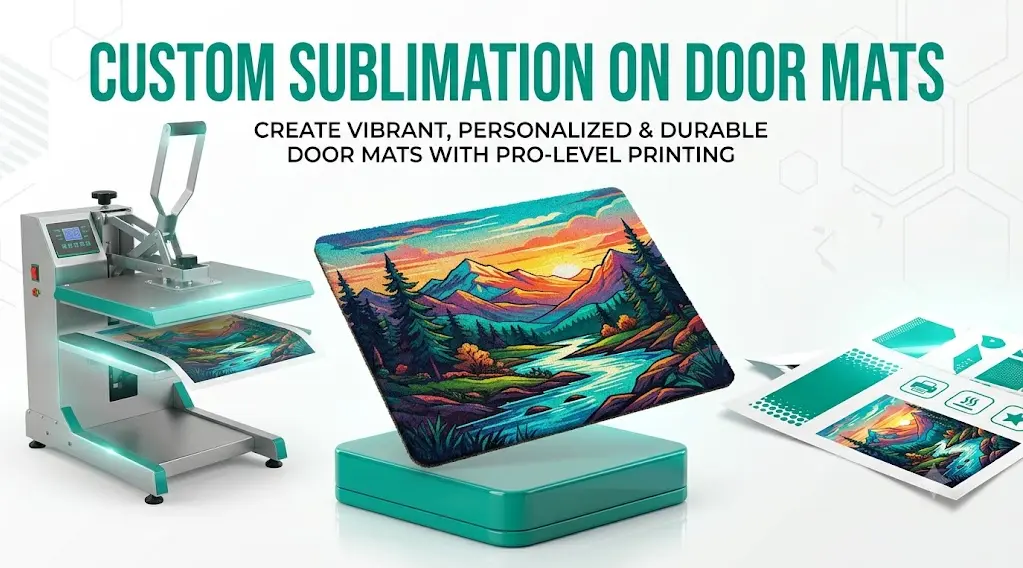
A custom doormat sells for $35 to $60 while the blank costs $8 to $15. That margin is why sublimation doormat blanks have become one of the fastest-growing hard goods in the craft market, and why the mat aisle is worth a serious look.
The catch is size. Mats demand more press real estate than any other blank most sellers own. Here’s the full workflow: what the blanks are made of, the equipment question, settings that work, and a dozen designs that actually sell.
How Custom Mats Actually Work
A sublimation mat blank is a two-layer sandwich: a smooth white polyester fabric top bonded to a black rubber base. The rubber grips the floor and frames the print; the polyester top is what takes the ink.
Under press heat, sublimation ink turns to gas and dyes those polyester fibers permanently. Nothing sits on the surface, no film, no cracking, no peeling underfoot. That’s what makes this method viable for something people literally walk on.
The usual rules apply: the top must be polyester (65% minimum, and purpose-made blanks are essentially 100%), the surface must be light-colored, and there’s no white ink, the white of the fabric is your white.
The Press-Size Problem
Standard craft presses are 9×12″ or 12×15″. Common mat blanks run 16×24″ up to 20×30″, so for a single full press, you need a large-format machine, typically 15×25″ or 16×24″ and up.
Can you press in sections with a smaller machine? Yes, and plenty of sellers do. You press one half, then carefully reposition and press the other, overlapping slightly. It works, but every repositioning is a ghosting risk.
Rule of thumb: if mats become a real product line, buy the big press. Sectional pressing is fine for testing demand; it’s too slow and too error-prone for twenty-mat order weeks.
Press Settings for Mat Blanks
Suppliers vary a little, but published settings cluster tightly. Start here, test on one blank, and adjust one variable at a time.
| Step | Temperature | Time | Pressure |
| Pre-press (moisture removal) | 385–400°F | 10 seconds | Light |
| Full press, large-format machine | 400°F | 45–60 seconds | Medium |
| Sectional press, smaller machine | 380–385°F | 60–70 seconds per section | Medium |
The pre-press matters more here than on shirts. Mat fabric holds moisture, and trapped steam is the number-one cause of splotchy, faded patches on an otherwise perfect print.
Step-by-Step: Pressing Your First Mat
- Design at full size: build the file at the mat’s exact printable dimensions, 300 DPI, and mirror it before printing.
- Lint-roll the surface: rubber sheds and fibers trap dust; every speck becomes a white dot.
- Pre-press 10 seconds: drives out moisture so the ink gases evenly.
- Tape the transfer face-down: heat-resistant tape on all four sides, large paper shifts easily.
- Protect both sides: butcher paper above and below stops ink blow-through and protects your platen from the rubber.
- Press at 400°F, 45–60 seconds, medium pressure: then lift straight up, no sliding.
- Peel hot and cool flat: let the mat rest flat so the rubber backing doesn’t warp.
12 Mat Design Ideas That Sell
Doormats are gift-market products, new homes, weddings, holidays. Design for the occasion and the buyer finds you.
- Classic “Welcome” in modern script: the bestseller baseline every shop needs.
- “Hope you brought tacos”: funny mats consistently outsell polite ones.
- Split monogram with botanical frame: the wedding-gift default.
- Family name + established year: the housewarming standard, easy to template.
- “Wipe your paws” with pet names: pet personalization commands a premium.
- Seasonal swap sets: sell autumn, Christmas, and spring mats as a rotating bundle.
- Business logo mats: storefronts, salons, and offices buy multiples and reorder.
- Realtor closing gifts: one realtor relationship can mean mats every single month.
- Teacher classroom mats: “Welcome to Ms. Carter’s class” appreciation-week gold.
- Campsite mats with family name: the RV crowd personalizes everything.
- “Go away” and introvert humor: a reliable niche with zero design cost.
- Grandparents’ house mats: “Grandkids spoiled here” grandparent gifting never slows down.
Design File Tips for Large Prints
Big blanks punish lazy files. A design that looks sharp on a phone screen can pixelate badly at 24 inches wide, so build at full physical size and 300 DPI from the start, don’t scale up a mug graphic and hope.
Keep text enormous by doormat standards. This product gets read from six feet away, standing up. Thin scripts that charm on a tumbler disappear on a porch; chunky serifs and bold scripts win.
And mind the edges. The rubber border eats 1 to 2 inches on every side depending on the blank, so keep names and critical elements well inside the printable area. Print one test sheet on cheap paper and lay it on the blank before committing ink to fabric.
Where to Buy Mat Blanks
Stick to dedicated sublimation suppliers rather than general marketplaces. Purpose-made blanks list the polyester content, the printable area, and recommended press settings, three specs random imports usually omit, and three specs you can’t work without.
Expect $8 to $15 per blank at case quantities for the common 16×24″ size, more for 20×30″. Order a couple of singles first, press them, hose them off, and leave one on your own porch for a month before buying by the case.
The Selling Angle
Mats hit a sweet spot: high perceived value, light enough to ship affordably, and personalization takes two minutes in a template. A $12 blank with a family name becomes a $50 product.
Bundle strategically. A closing-gift set, mat plus matching tumbler, raises your average order without raising your customer-acquisition cost. B2B buyers like realtors and property managers order in repeat batches, which beats chasing one-off retail sales.
And the workflow transfers. The same printer, inks, and design skills run polyester apparel, where bulk orders live. Our sublimation shirt and hoodie guides cover that side when you’re ready to scale past hard goods.
Conclusion
Mat printing is simple physics on a bigger canvas: polyester top, real heat, serious pre-press, and enough platen to cover the blank. Start with sectional presses to test demand, then invest in large-format once orders prove out.
FAQs
Can you wash a sublimated doormat?
Yes, hose it off or spot-clean with mild soap. The dye is inside the polyester fibers, so scrubbing won’t lift it. Skip the washing machine; agitation stresses the rubber backing.
Will the print fade outdoors?
Under a covered porch, mats hold color for years. In direct daily sun, any dye-based print slowly fades, sell uncovered-entry buyers on rotation sets and honest expectations.
What size heat press do I need for mats?
For single presses of common 16×24″ blanks, a 15×25″ or larger machine. Smaller presses work in overlapping sections, but expect slower production and a learning curve on alignment.
Why does my mat look faded in patches?
Almost always moisture. Mat fabric absorbs humidity, and steam blocks ink transfer in blotches. Pre-press for 10 seconds before applying the transfer and the patches disappear.