
Hockey Jersey Materials and Fabrics Explained for Team Buyers
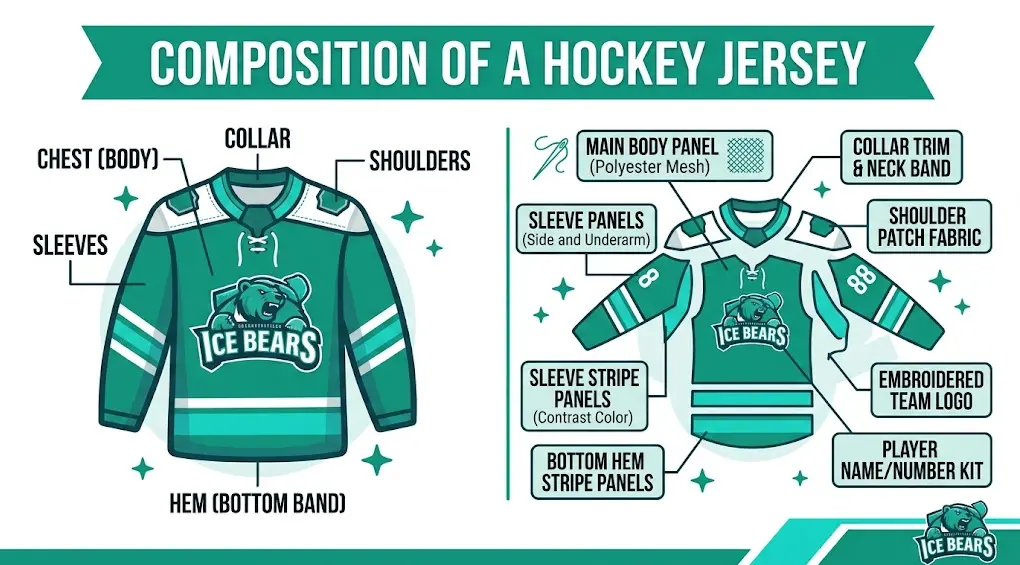
The fabric decides more than the feel of a hockey jersey. It affects decoration, durability, breathability, weight, and how well the garment fits over pads.
For team orders, material choice should match the level of play and the decoration method.
A practice jersey, sublimated team jersey, and pro-style game jersey should not all be judged by the same fabric standard.
Polyester is the core fabric
Most modern hockey jerseys use polyester because it handles moisture, holds shape, and works with sublimation. Mesh and interlock constructions can change the weight and feel.
For sublimated pieces, polyester content is especially important because the dye needs compatible fibers.
Use this quick checklist before moving forward:
- Polyester content: Important for sublimation and moisture handling.
- Mesh or interlock construction: Changes feel, airflow, and durability.
- Fabric weight: Heavier builds usually cost more.
- Shoulder and elbow reinforcement: Useful for heavier play.
- Decoration compatibility: Choose fabric around the decoration method.
Match weight to use case
A lightweight practice top does not need the same structure as a game jersey. Heavier builds can feel more durable, especially when the garment is worn over pads and takes regular contact.
Some pro-style pieces add double shoulders, double elbows, or other reinforcements.
Think about decoration before choosing fabric
Sublimation works best with polyester-heavy fabric. Tackle twill and heat-applied lettering need surfaces that can handle pressure, heat, and possible dye migration.
If the team wants a specific decoration method, choose the fabric around that decision.
Have a Look at Our Specially Designed Hockey Uniforms Through Sublimation.
Ask suppliers better questions
Do not stop at color and price. Ask about fabric content, weight, reinforcement, breathability, goalie cuts, and care instructions.
Those answers reveal whether the jersey is built for the way your team will use it.
Do not compare jerseys by fabric name alone
Two jerseys can both be polyester and feel completely different. Knit structure, weight, stretch, and reinforcement all change the final garment.
That is why a buyer should ask for construction details, not just a fabric label.
Decoration and fabric should be planned together
If the design will be sublimated, the fabric must support that process. If the team wants twill or heat-applied details, the fabric must handle pressure, heat, and possible dye movement.
Choosing decoration after the fabric can limit the design.
Durability costs less than replacement
A heavier or reinforced jersey may cost more upfront, but it can make sense for teams that play hard, travel often, or wash gear constantly.
For light practice use, a simpler build may be enough.
Details worth verifying before you order
This is where a generic article usually stays vague. A real team buyer should check the operational details that affect price, timing, fit, and whether the finished jersey matches the proof.
Use these checks to turn the article advice into a cleaner purchase:
- Practice check: Lightweight and breathable. Before approval, use this as a real order checkpoint: will it hold up to weekly washing?.
- Game check: Durability and structure. Before approval, use this as a real order checkpoint: are shoulders or elbows reinforced?.
- Sublimation check: Polyester compatibility. Before approval, use this as a real order checkpoint: what is the fabric content?.
- Goalie check: Room and heavier wear zones. Before approval, use this as a real order checkpoint: is there a goalie-specific cut?.
Common mistakes to avoid
Most team-order mistakes happen before payment, when the roster, sizes, artwork, and deadline are still half-confirmed.
- Approving scattered details: Use one roster and one proof as the final source of truth.
- Forgetting reorders: Late players and replacements are normal in hockey.
- Treating goalies like regular players: Goalie cuts need their own fit plan.
- Skipping sock decisions: Matching socks are harder to color-match later.
A practical team-order workflow
Start with the roster, then the artwork, then the mockup, then the payment. That order keeps the team from designing something beautiful around incomplete information.
Before the final sign-off, have one person outside the design process review the roster and proof. Fresh eyes catch the simple errors everyone else missed.
Fabric Decision Guide
| Use case | Fabric priority | Buyer question |
| Practice | Lightweight and breathable | Will it hold up to weekly washing? |
| Game | Durability and structure | Are shoulders or elbows reinforced? |
| Sublimation | Polyester compatibility | What is the fabric content? |
| Goalie | Room and heavier wear zones | Is there a goalie-specific cut? |
Pro tip: If a quote does not mention fabric type or weight, ask. Price without construction details is hard to compare.
Conclusion
Fabric choice controls fit, durability, decoration, and care. For team buyers, the right jersey starts with polyester content, construction weight, reinforcement needs, and the decoration method. Use it as the final checkpoint before approving a custom order.
FAQs
What fabric are hockey jerseys made of?
Most are polyester-based, often in mesh or interlock constructions.
Is polyester good for hockey jerseys?
Yes. It manages moisture, works well for sublimation, and handles teamwear use better than cotton.
What GSM is best for ice hockey jerseys?
It depends on use. Practice jerseys can be lighter, while game and pro-style jerseys often use heavier fabric.